Showing posts with label beer. Show all posts

Wednesday, April 25, 2007

Coco-Krausen: Brewing with Ovaltine

Boiling the Ovaltine HardCrazy for Coco-Krausen?
As part of my Ovaltine experiment, I brewed a bigger 12 litre batch yesterday. I also boiled up some invert sugar to go with it. Here are the details of the Brewing a Beer with Ovaltine Experiment. The recipe became more complex as I fiddled with it. Maybe I should have kept is simple stupid, but I love the complexities.


I started with 1.2kg of Ovaltine in 10 litres of water. This has a specific gravity of about 1.050 in the kettle, if my calculations (guesses) are correct. This gravity is ok for hop utilization. I boiled it hard for 15 minutes and scooped the fat and protein that separated and floated in the foam. I take it that whey powder and milk solids were the grey blobs that were floating up on the side of the pot.


I added 14g of Nugget hop pellets at 15 minutes. I then let it roll hard for another 30 minutes before adding 14g of Cascades as finishing hops. With about five minutes left in the hour-long boil I added 500g of inverted, caramelized brown sugar which I made while watching the boil.

These are the added ingredients that I did not plan on until the last minute. I also added 2 teaspoons of instant coffee and 1 teaspoon of cinnamon. Apparently, cinnamon in an antioxident and hey, I like Ovaltine in my coffee, so it can't be all that bad. I finished the boil and chilled in a bucket of ice water. I added the thick wort the fermenter and added fresh water to 12 litres. I shock it like mad and picthed a package of Munton's Gold ale yeast that I had rehydrated earlier.

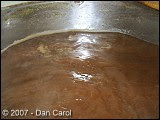
For being a fairly high-gravity brew (1.080?), it was roaring in a few hours! The zillions of happy yeasts were chowing on the chocolate wort making some kind of coco-krausen. See photo. It's been a day and a bit and the experiment seems to be going ok. The smell from the fermenter is of malt, chocolate, hops and fruit. I am guessing that the fruity aroma is coming from some kind of reaction with the cocoa? Or perhaps the inverted, caramelized brown sugar? Anyways, it sure smells good.

When the fermentation is complete, I will rack into a secondary with some gelatin in it. I hope to be able to clear the beer, but have not researched much in the way of finings yet. This is a comepletely different kettle of coco compared to real beer brewing.


Happy brewing!

Monday, April 23, 2007

Wacky Ovaltine Beer Experiment

Ovaltine as beer ingredient?Malted Milk
Most of you will know what Ovaltine is. It's a malted milk drink powder that you mix with water or milk. In the UK Ovaltine is popular, in other parts of the world, Nestle's Milo is popular. After doing some research, reading packages, nutrition web sites, ingredients, etc., I've come up with an experiment to use Ovaltine as a base for beer. If you hadn't guessed it already, malt extract is a big part of these malted milk drink mixes. I will brew up a small batch and experiment with a recipe that I have formulated to make what is essentially 4 litres of some kind of strange chocolate ale.

Here's what I am thinking...

Boil up 500g of Ovaltine in 5 litres of water. I don't know if the yeast will have enough nutrients from Ovaltine alone, so I'll chuck in a teaspoon of dry bakers' yeast in the boil. Add a pinch of bittering hops, boil some more and add some finishing hops, cool, aerate and pitch an ale yeast on it. After a week, I'll rack it onto some gelatin and see how she clears. It will very likely taste like beer as Ovaltine's principal ingredients are sugar, malt extract and glucose.

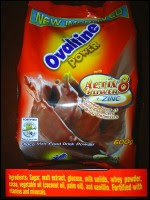
Here are the ingredients from the label of the Philippines version of Ovaltine:
Ovaltine ingredients

The ingredients that are bad for beer have little Xs near them, the ingredients that are not bad for beer have little check marks. Sounds pretty neat eh? I'll be take lots of notes and preparing a detailed blog entry to keep everyone aware of what's happening in the laboratory. LOL

Sleep now, it's been a long day.

Thursday, April 12, 2007

Malting at Home Guide

More Home Malt on the WayFor anyone who is interested, I published a condensed guide on Bodensatz (The Beer Site) about malting at home. If you like, you can click here to to have a look at the guide. There are lots of pictures and step-by-step instructions. I hope that some of you homebrewers find it useful, whether you are in the Philippines or not.

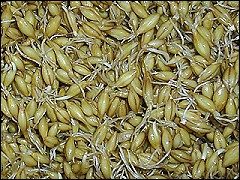
The malting is going well and the barley is fully modified and in the sun drying as I write. The system is getting more efficient as I learn. See the photo at left. That is fully modified.

I've been thinking lately and because I am always in the mood to experiment, I have come up with two possible experiments.

Experiment #1:
I had a Cali Shandy the other day and very much enjoyed it. I would like to try to brew something along the lines of a pineapple accented beer. If anyone has any recipes please let me know. My guess would be to add some fresh pineapple to the wort, but I am not sure how the citric acid would effect the wort pH. Probably it wouldn't lower it enough to be of a concern. Yeast like a lower pH environment of between 5.2 and 5.6.

Experiment #2:
We eat a lot of ampalaya and grow it in the garden here. I tasted some ampalaya leaf the other day and noticed a similarity with fresh hops; super bitter that is. I want to add some ampalaya leaves to the boil on my next batch. Maybe I'll split the boil into two and try some with ampalaya and some without.
We'll see how my 10 litre batch goes. It's clearing now. We may be able to bottle soon.

Maltster... over.

Sunday, April 8, 2007

One Step Closer to 100% Homemade Beer

All Crushed and Ready to MashBrew Day at Last!
I thought I would keep you guys posted on my malting at home experiment.

Today, I did a 10 litre mini-batch with the generic malt I made. All manually crushed with a rolling pin (lots of work) like I mentioned before. For 3 kilos it took me over an hour!

I mashed with a 3.4:1 water to grain with 3kg of malt. I did a long 60 minute protein rest at 45ºC to 50ºC because I don't know the protein content of the malt. If it is heavy in protein I hope this will help. If it's lighter on protein the beer will likely be headless. Going for sweet and fermentable, I went by taste on the beta amylase rest. It rested long and low as I held in for 90 minutes at 60ºC. I want to see how sweet this stuff can get.

I suspect that the malt could have been modified more or I did something to disable some of the enzymes during kilning. More things to try next time.

I found gobs of greyish suspended gloop that looks like cauliflower blobs (proteins?) would glom together when the my makeshift tun was undisturbed. I sparged and more sweet stuff came trickling out. The sparge took about 20 minutes for 5 litres. Maybe something was sticking a bit. Maybe over crush.

I boiled the sweet smelling wort for an 75 minutes. 15 minutes for scunge skimming and 60 minutes with hops in. I got a good hot break. I hopped it with 1/2 oz of Magnum pellets and 1/2 oz of Cascades at 45 minutes. When I chilled in the ice bath I could see more globs forming. Aerated and pitched with 1 package of re-hydrated Cooper's ale yeast. Total yield was just over 10 litres.

I have no idea what kind of beer this is going to be. I hoped to make something quite bitter and dry. Hopefully the yeast has the punch to take the FG down low. Staying away from the alpha amylase rest was the idea there. The color is very light and I suspect it will be quite a pale ale, probably more like a lager in looks.

All good fun. Considering that the unknown in my recipe is the malt, and making malt can be just as much an art as making beer. I'll let you know how it turns out. I expect to hear the airlock to be calling me soon.

This is truly 'seat of the pants' homebrewing in the Philippines.

Cheers!

Saturday, March 10, 2007

Ambient Temperatures in Brewing Ales

Today, I am researching the effects of higher than ideal fermentation temperatures and simple "homemade" solutions to overcome some of these problems.

I recently listened to a podcast from Basic Brewing Radio featuring homebrew author John Palmer. The host James Spencer and John talked about issues of high fermenting temperatures. The gist of it is: High temperatures during fermentation can produce off flavors, but the most important time to have a cooler wort is when pitching. Increases in temperatures after the yeast's growth phase are acceptable, but not too high. From what I have gleaned from research and that podcast is that 90° F (32.2° C) as the absolute maximum temperature, of course this will depend on the yeast used. When I say absolute maximum this is not what I consider an ideal fermentation temperature.

What is deemed most important for hot climate brewing is the pitching temperature. With an ice bucket pre-chiller and immersion wort chiller I will certainly be able to get the wort to 20° prior to pitching the yeast. If I wrap the primary fermenter with some insulation the wort temperature should remain low and fairly constant until the yeast growth phase is complete. After the growth phase is complete the brew temp can increase as long as it doesn't get too warm.

I would like to build an insulated box with a place for an ice tray. I'd need a week's worth of ice, but can make a few bags of ice a day to keep the system cool. This box would allow me to use lager yeast and brew at cooler (10° C) temperatures, but I'd be happy with 15 to 17° C and a nice ale.

So as I build my mini brewery, I will be on the lookout for ways to keep things cool with ice. My shopping list now includes some lengths of copper pipe, a few pieces of garden hose, fittings and a sheet of rigid polystyrene. I know I can get the plumbing parts, but the 'am not sure about the polystyrene. I have seen plans on the web for a brew box that's made of polystyrene. It's rigid and easy to work with. I could also buy or build a wooden box and line it with something. Perhaps something native or spray the inside with insulating foam spray. More things to keep my eyes peeled for.

My next research project is about malting. There is a grains dealer about 4km from the house here. (we're semi-rural) I saw a bag of barley the last time we went past on the jeepney. Hmmm, home malted barley? Pwede!

'till next time...cheers.