Showing posts with label barley. Show all posts

Monday, April 2, 2007

Down By The Old Malt Mill

Gee, I wish I had a barley mill. I want to experiment with the malt I've made and want to check out how it looks, feels and behaves compared to commercially available malts I've used before.

Waiting For Brew DayDiastatic Power
One thing of most interest is the diastatic power of the malt. A well modified base malt will have at least 20% more muscle so that things that cannot self convert their own starch can be included in the mash. The base malt has the extra amylase to convert other things such as corn, rice, unmalted barley and oatmeal. The amylase enzymes float around in the mash at 60 to 70ºC chomping all that starch into sugars.

Extract brewers need not worry as all the sugars are already available. So with extract recipe no enzymes are needed. Enzymes are denatured (killed) in the evaporation and or drying processes.

Anyways, back to the mill. The idea of a barley mill is to crush the grain and not shred its husk. We are going to need the husk intact to act as a filter in the lauter tun (aka cooler). We also don't want the seed to be pulverized into powder as the flour can cause gummy blobs that block the flow from the lauter tun and cause 'stuck mashes'. So the job the mill has to do is like a rolling pin with enough force to crumble the insides of the seed and yet leave the husk in pretty good shape.

Git Yer Rollin' Pin
Seeing as though I have no real barley mill, but I do have a rolling pin I thought I'd give that a go. By placing a few cups of malt in a heavy duty plastic bag I began rolling and crushing. I did this in the kitchen on the big cutting board.

The result was pretty good and looked consistent with what I was hoping for in a crush. Now a few cups is a few cups, but I have lots of cups to crush.

It's a lot of work, it's hot and I am getting thirsty. I guess I am going to have to make some beer soon.

Cheers!

Saturday, March 24, 2007

More on Modification

After 24 hours of germinatingG'day mates!

Today is Hot and Slow
Yestday was a slow day and a hot one. I rinsed and stirred barley on and off for the whole day. I did manage to get some work done on the computer, but barley was the thing on my mind. I listened to Oz Craft Brewer Radio's 2 podcasts on malting at home and picked up a few tips. I like listening while I work. Programming is fun, but beer is funner.

The grain is starting to spout in heavier numbers now. I keep them under a fan in two big tubs. The depth of the barley is about 4 inches (100mm) and it's kept moist with a squirt bottle with water and a little bleach. So far nothing overly exciting to report, just more sprouting. It's in the 30's here in the daytime, so I am wondering what the higher temperatures do to the germination process. I popped the thermometer into the grain yesterday and measured a lovely 31ºC. I know that the grain itself is generating heat too.

When I get this germination phase over with, I am going to stew some and try to make a crystal malt. As far as I can tell, a crystal malt is taken from the germination bed 'green' and stewed at 50ºC for an hour to cause the amylase to kick into action. The amylase converts the starch in the endosperm into maltose. This is why crystal malt is so sweet and sugary. Once stewed, the crystal malt is dried. Because we're not overly worried about preserving the enzymes or its diastatic power, we can crank up the heat and make a variety of coloured crystal malts.

For leisure last night I studied all the different kinds of malt. There are dozens of varieties and even more variation from malthouse to malthouse. I don't have a giant rotating drum roaster, but I can improvise.

Our friend is coming back from Cebu today and we're going to pick her up at the airport soon.

Stay tuned!

Thursday, March 22, 2007

Modification of Barley

Steeping in bucket of water
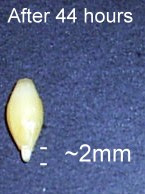
I've been soaking the barley seeds and straining for an air rest, then soaking again to induce the seeds to germinate. This morning after about 40 hours of steeping, I noticed some little roots coming out of the barley. Success!


It's now time to start the germination phase and keep the grain moving and moist until it's ready to dry. I've been listening to the many podcasts on producing malted barley products and I am excited to try the drying and roasting of the barley.


I have no idea of how this going to work out, but I am going to keep everyone posted as to how it does.


Cheers!

Modification of barley

Wednesday, March 21, 2007

Malting Barley at Home, Finally

Barley is GoodBarley Ahoy!
Yesterday was a big day here in the sticks. I found a place that sells barley! It struck me when I was looking for info on the net and found the wikipedia entry for barley. Most of the barley in the world is grown for animal feed. Wow, what a concept. I went to the feed place a few km down the road and sure enough, two-row BARLEY! There was also wheat (trigo), oats and much more.

The funny part was when the guy there asked me "How many cocks do you have, Sir?" I said, "Uh...what?" He thought I was going to use the barley to feed my fighting cocks. I explained that barley was the main ingredient in cerbeza. Ah, he understands now. After all, you can't have a cock fight without beer.

So I ended up with 6kg in bag. I expect this 6 kilos to yield about 5 kilos when malted. Five kilos of malted barley is worth about $15 plus shipping. The raw barley is about 10 cents a pound or about $1.30 all up.

I started the soaking last night and the barley is swollen to almost twice the size already. I am soaking for 8 hours and then air resting for 1 to 2 hours. Soaking will be done tomorrow and then we'll start the germination phase.

Also, if anyone is looking for a 0ºC to 100ºC thermometer, labratory grade, they have them at Mercury Drugs for P170.

Gotta work na.

Saturday, March 10, 2007

Ambient Temperatures in Brewing Ales

Today, I am researching the effects of higher than ideal fermentation temperatures and simple "homemade" solutions to overcome some of these problems.

I recently listened to a podcast from Basic Brewing Radio featuring homebrew author John Palmer. The host James Spencer and John talked about issues of high fermenting temperatures. The gist of it is: High temperatures during fermentation can produce off flavors, but the most important time to have a cooler wort is when pitching. Increases in temperatures after the yeast's growth phase are acceptable, but not too high. From what I have gleaned from research and that podcast is that 90° F (32.2° C) as the absolute maximum temperature, of course this will depend on the yeast used. When I say absolute maximum this is not what I consider an ideal fermentation temperature.

What is deemed most important for hot climate brewing is the pitching temperature. With an ice bucket pre-chiller and immersion wort chiller I will certainly be able to get the wort to 20° prior to pitching the yeast. If I wrap the primary fermenter with some insulation the wort temperature should remain low and fairly constant until the yeast growth phase is complete. After the growth phase is complete the brew temp can increase as long as it doesn't get too warm.

I would like to build an insulated box with a place for an ice tray. I'd need a week's worth of ice, but can make a few bags of ice a day to keep the system cool. This box would allow me to use lager yeast and brew at cooler (10° C) temperatures, but I'd be happy with 15 to 17° C and a nice ale.

So as I build my mini brewery, I will be on the lookout for ways to keep things cool with ice. My shopping list now includes some lengths of copper pipe, a few pieces of garden hose, fittings and a sheet of rigid polystyrene. I know I can get the plumbing parts, but the 'am not sure about the polystyrene. I have seen plans on the web for a brew box that's made of polystyrene. It's rigid and easy to work with. I could also buy or build a wooden box and line it with something. Perhaps something native or spray the inside with insulating foam spray. More things to keep my eyes peeled for.

My next research project is about malting. There is a grains dealer about 4km from the house here. (we're semi-rural) I saw a bag of barley the last time we went past on the jeepney. Hmmm, home malted barley? Pwede!

'till next time...cheers.